Views: 157 Author: Site Editor Publish Time: 2026-08-03 Origin: Site
High-volume environments frequently underestimate the cumulative cost of replacing dried-out, low-quality whiteboard markers and repairing ghosted presentation surfaces. Procurement managers, school administrators, and office coordinators struggle to balance unit cost with operational longevity, user safety, and surface preservation when selecting writing instruments. Choosing the right marker involves more than picking a color; it requires understanding ink formulations, tip architecture, and proper maintenance protocols.
This guide provides a technical evaluation of dry erase markers, detailing how to match ink formulations to specific use cases, maximize product lifespan through proper usage, and optimize bulk purchasing strategies. You will learn how to prevent premature dry-out, select the correct tip style for your environment, and evaluate suppliers for large-scale procurement.
Formulation Dictates Performance: Selecting a low odor whiteboard marker is critical for enclosed classrooms and conference rooms, though it requires specific solvent bases that impact drying time.
Maintenance Extends ROI: Proper storage (horizontal) and surface compatibility checks prevent premature tip dry-out and irreversible board ghosting.
Strategic Procurement: Purchasing bulk whiteboard markers for schools or corporate offices requires evaluating suppliers on cap-off time guarantees and volume discount tiers, not just initial unit price.
Branding Utility: Custom logo markers offer high-visibility, low-cost promotional value for marketing when sourced through reliable manufacturers.
Understanding why markers fail requires analyzing the chemical interaction between ink, polymer release agents, and the writing surface. The formulation directly dictates how well the ink wipes away after use. When you apply ink to a board, a complex chemical process occurs in milliseconds. The solvent evaporates, leaving behind a pigmented polymer film. If this film binds directly to the board, you get permanent ghosting. If the release agent functions correctly, the film sits on top of the surface, ready to be wiped away.
The solvent acts as the delivery mechanism for the pigment. When you write on a board, the solvent evaporates rapidly. A specialized silicone polymer release agent forms a microscopic barrier between the pigment and the board surface. This barrier prevents the pigment from binding to the board, allowing for dry wiping. The evaporation rate of the solvent determines the curing time of the ink. Fast-evaporating solvents cure almost instantly, while slower ones require a brief pause before erasing to prevent smearing.
Different solvents interact differently with various board materials. For instance, highly porous melamine boards absorb slower-evaporating solvents, pulling the pigment into the board's microscopic crevices. This is the primary cause of ghosting on older or cheaper whiteboards. Non-porous surfaces like tempered glass or porcelain-on-steel resist solvent absorption entirely, making them the ideal pairing for any solvent type.
Standard markers often use ketone-based solvents like methyl isobutyl ketone. They deliver bolder, darker colors but emit strong volatile organic compounds (VOCs). In contrast, alcohol-based formulations provide a safer alternative. Selecting a low odor whiteboard marker ensures compliance with indoor air quality standards in educational and corporate settings, minimizing respiratory irritation in enclosed spaces.
Alcohol-based inks typically use ethanol or isopropanol. While these solvents are much less pungent, they can sometimes result in slightly less vibrant colors compared to their ketone counterparts. However, advancements in pigment dispersion technology have largely closed this gap. Modern alcohol-based markers offer excellent visibility without the headache-inducing fumes, making them the standard for modern classrooms and unventilated meeting rooms.
Matching the physical design of the marker to the specific presentation or educational requirement improves visibility and user experience. Different environments demand different line widths and ink capacities. The nib material, usually compressed polyester or acrylic, determines how ink flows from the reservoir to the writing surface.
Manufacturers produce several tip styles to accommodate various writing needs. Chisel tips offer versatile line widths, making them ideal for large conference rooms where visibility from a distance is necessary. Bullet tips provide consistent, thick lines, well-suited for classroom settings. Fine point tips are required for individual student whiteboards or detailed office kanban boards where precision matters.
Tip Style | Line Width | Best Use Case | Durability |
|---|---|---|---|
Chisel | Variable (Broad/Fine) | Large conference rooms, bold headers | High |
Bullet | Consistent Medium | Classrooms, general writing | Very High |
Fine Point | Consistent Thin | Personal whiteboards, detailed charts | Medium |
Ultra-Fine | Very Thin | Planners, calendars, small text | Low |
Cap-off time measures how long a marker can remain uncapped before the tip dries out. This metric is crucial for bulk purchases, as users frequently forget to replace caps. Evaluating barrel volume versus actual usable ink yield helps determine the true lifespan of the product. A larger barrel does not always mean more ink; the density of the internal ink reservoir (the tampon) dictates how much fluid the marker actually holds.
High-quality markers utilize advanced reservoir materials that hold more ink and release it consistently. Cheaper alternatives often use low-density fibers that trap ink, resulting in a marker that stops writing even when it still contains fluid. When evaluating options, request specifications on the actual milliliter volume of ink, rather than just looking at the external dimensions of the barrel.
Improper usage leads to rapid inventory depletion and damaged whiteboards. Implementing standard operating procedures for marker use extends their lifespan and protects expensive presentation surfaces. Training staff and students on these basic principles can significantly reduce annual procurement costs.
Always identify safe surfaces before writing. Melamine, porcelain, and glass boards are designed for dry erase ink. Avoid using dry erase markers on porous materials like unfinished wood, drywall, or standard paper. These materials absorb the solvent and trap the pigment, resulting in permanent stains. Even painted walls, unless coated with a specific dry erase paint, will absorb the ink.
Store markers horizontally. This orientation keeps the tip saturated with ink without causing pooling at either end. If a marker temporarily dries out, you can often revive it using specific techniques.
Check the cap for damage or cracks that might be letting air in.
Store the dried marker tip-down for 24 hours to allow gravity to pull remaining ink into the nib.
If gravity fails, securely tie a string to the back end of the marker.
Spin the marker rapidly in a circle to apply centrifugal force, pushing ink toward the tip.
Test the marker on a non-porous surface. If it still fails, the solvent has completely evaporated and the marker must be discarded.
Allow the ink a few seconds to cure before erasing. Wiping immediately smears the wet solvent and pigment across the board. Use microfiber cloths and specialized cleaning solutions periodically to remove residual polymer buildup and prevent ghosting. Avoid abrasive cleaners or standard glass cleaners containing ammonia, as these strip the protective factory coating off whiteboards, making them more susceptible to future ghosting.
Beyond standard writing, dry erase ink possesses unique chemical properties that solve common office and classroom problems. Understanding these properties allows you to handle accidental damage and improve daily workflows.
If someone accidentally uses a permanent marker on a whiteboard, you can remove it using a fresh dry erase marker. Trace over the permanent ink heavily. The solvents in the dry erase ink act as a solvent for the permanent ink polymer, breaking it down so both can be wiped away easily. This works because both marker types use similar non-polar solvents; the dry erase marker simply re-introduces the solvent along with its release agent.
When ink gets on clothing, hands, or upholstery, act quickly. Rubbing alcohol or alcohol-based hand sanitizer breaks down the pigment on skin. For fabrics, specialized spot removers or a dab of rubbing alcohol applied before washing can mitigate permanent staining. Never use hot water initially, as heat sets the pigment into the fabric fibers.
Utilize multi-color bulk whiteboard markers for schools and offices to improve visual organization. Assigning specific colors to different project phases or subjects enhances cognitive retention and project management flow. For example, use black for standard text, red for critical action items, and green for completed tasks. This visual hierarchy speeds up information processing during fast-paced meetings.
Teachers and parents can use dry erase markers to conduct interactive STEM learning activities, demonstrating chemical properties in a visual format. This experiment perfectly illustrates the function of the release agent.
The insoluble silicone polymer release agent and the buoyancy of the dried ink allow a drawing on a smooth surface to peel off and float when water is introduced. The ink does not dissolve in water; instead, the water slips underneath the release agent, lifting the intact drawing. Because the polymer is less dense than water, it floats.
Obtain a clean, glossy ceramic plate or a shallow glass bowl.
Draw a simple, connected shape (like a stick figure or a star) using a fresh dry erase marker.
Allow the ink to dry completely for about 5 to 10 seconds.
Slowly pour room-temperature water onto the plate, aiming near the edge of the drawing rather than directly on top of it.
Watch as the water seeps under the drawing, detaching it from the ceramic surface so it floats.
Differentiating between temporary and semi-permanent marking needs prevents accidental erasure and improves operational efficiency. Using the wrong marker type for a specific application causes frustration and wasted time.
Choose dry erase markers for high-turnover boards, daily brainstorming sessions, and rapid iteration environments. They are designed for quick-changing markings where immediate erasure is required. They excel in environments where information changes hourly or daily.
Select wet erase markers for long-term scheduling, restaurant menu boards, and templates. Wet erase ink requires a damp cloth to remove, ensuring that accidental brushing or environmental humidity does not erase the content. The ink forms a hard, smudge-proof layer once dry, making it ideal for grid lines or permanent headers on a scheduling board.
Institutional buyers must evaluate factors beyond retail pricing to optimize procurement budgets and ensure consistent supply. Buying in bulk requires a strategic approach to vendor selection and product specification.
When shortlisting an office whiteboard marker supplier, prioritize consistent inventory, batch quality control, and reliable shipping logistics. Requesting sample batches allows you to test cap-off times and color vibrancy before committing to a large order. Check their track record for backorders and their policy on defective batches.
Analyze dry erase marker wholesale pricing structures. Calculate volume discount thresholds and factor in freight costs to determine the true landed cost per unit. Sometimes, a slightly higher unit cost from a domestic supplier is more economical than a lower unit cost from an overseas supplier once shipping and customs delays are factored in.
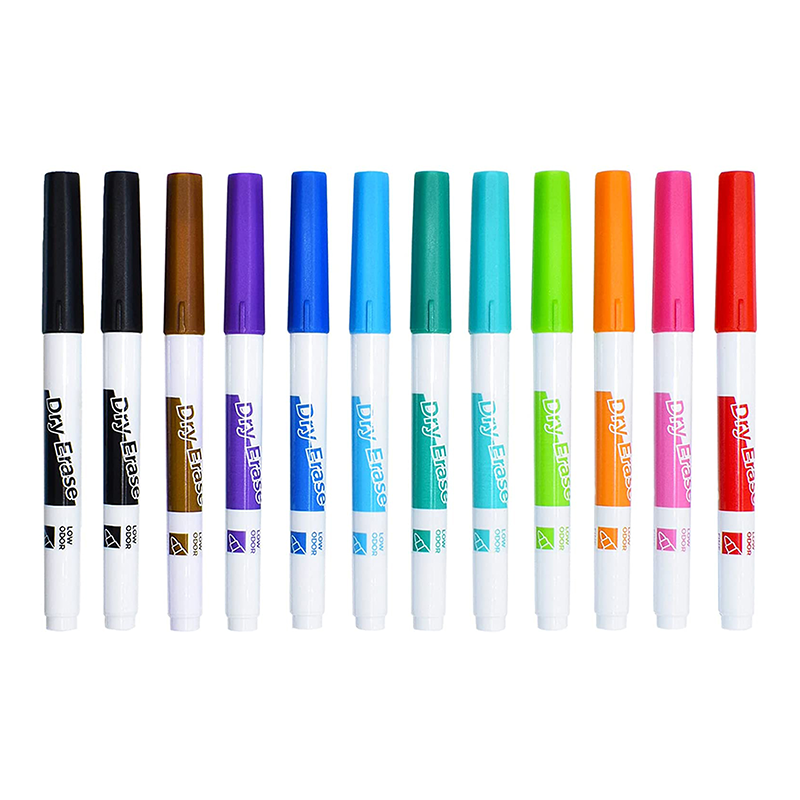
Educational procurement requires specific criteria. Prioritize low-odor certifications (such as AP non-toxic), durable nibs that withstand heavy pressure from students, and multi-color pack availability to support diverse teaching methods. Nibs that lock into the barrel prevent students from pushing the tip inside the marker, a common issue in elementary classrooms.
Functional office supplies serve as effective marketing collateral when customized appropriately. A marker sits on a client's desk for months, providing continuous brand exposure.
Evaluate print methods like pad printing versus screen printing on marker barrels. Pad printing accommodates curved surfaces well, while screen printing offers bold, durable logos. A custom logo dry erase marker provides high ROI for trade shows, corporate training seminars, and client onboarding kits. Ensure the manufacturer uses UV-cured inks for the logo so it doesn't rub off from the friction of daily use.
The optimal dry erase marker strategy requires aligning ink chemistry and tip durability with the specific environmental demands of the user. For schools, prioritize AP-certified, low-odor bulk purchases. For executive boardrooms, prioritize bold, chisel-tip markers with high cap-off times. For promotional needs, focus on custom branding capabilities.
Audit your current marker consumption rates across all departments to establish a baseline.
Assess whiteboard surface health to determine if ghosting is caused by degraded boards or low-quality markers.
Request sample batches from a verified supplier to test cap-off times and ink vibrancy in your specific environment.
Establish a standardized color-coding protocol for office project boards to improve workflow efficiency.
A: The average lifespan ranges from 1 to 3 months in high-use environments. This depends on cap-off time, storage orientation, and frequency of use. Storing them horizontally extends their usable life significantly by keeping the nib saturated.
A: Ghosting occurs due to the breakdown of the release agent, erasing before the solvent fully evaporates, or using markers on degraded or porous melamine surfaces. Regular cleaning with specialized solutions helps prevent this buildup.
A: You can revive a marker by storing it tip-down for 24 hours to allow gravity to pull ink back into the nib. Alternatively, securely tie a string to the back end and spin it to apply centrifugal force, pushing ink toward the tip.
A: Low odor markers use alcohol-based solvents instead of harsh ketones, making them safer and less irritating. However, basic ventilation is still recommended for prolonged use in enclosed spaces to maintain optimal indoor air quality.
A: Yes, they are safe for glass boards. However, standard dry erase ink may appear translucent or faint on glass surfaces. We recommend using specialized glass board markers formulated for higher opacity and contrast.
A: Dry erase markers use a polymer release agent for immediate dry wiping. Wet erase markers use a paste-like ink that requires a damp cloth to remove, preventing accidental smudging from hands or environmental moisture.