Views: 146 Author: Site Editor Publish Time: 2026-08-07 Origin: Site
Sourcing writing instruments for corporate procurement, retail distribution, or promotional campaigns is often treated as an afterthought. This mindset usually persists until defective batches, dried-out ink, or poor branding execution damage end-user trust. Buyers must evaluate a fragmented market of suppliers. You have to balance unit economics with technical reliability. Selecting the wrong manufacturing partner can lead to toxic ink compliance failures, inconsistent barrel printing, or supply chain bottlenecks. You need a reliable highlighter pen that performs consistently across different paper types.
This guide provides a technical evaluation framework for assessing ink formulations, tip architecture, customization capabilities, and supplier reliability. We will help you ensure your next bulk order meets strict quality and compliance standards. You will learn exactly how to match the right ink delivery system to your specific end-user requirements.
Match Tip and Ink to the Application: Standardizing on a chisel tip provides the highest versatility for diverse end-users, but ink formulation (water-based, liquid, gel, or wax-based) dictates bleed-through and smear performance on specific paper weights.
Prioritize Chemical Compliance: Always require documentation from a verified non-toxic highlighter supplier to ensure compliance with international safety standards (e.g., ASTM D-4236, EN71, REACH).
Evaluate Overall Lifecycle Value: The lowest unit price often hides risks like short shelf life, ink evaporation, or high defect rates; factor in Quality Assurance (QA) and shipping logistics when purchasing wholesale.
Distinguish Between Sourcing Models: Choose an off-the-shelf wholesaler for rapid deployment, or an OEM manufacturer for proprietary barrel designs, custom ink delivery systems, and exact Pantone color matching.
You must establish clear project parameters before contacting suppliers. Different use cases demand entirely different product specifications. A hospital requires different features than a marketing agency. We see buyers make the mistake of ordering standard office supplies for specialized field work. You need to map the physical product to the actual daily workflow of the person holding it.
Define the primary use case immediately. Promotional projects prioritize exterior barrel aesthetics and eye-catching designs. When you order custom logo highlighter pens, the durability of the exterior print matters most. The pen acts as a physical billboard for your brand. Users will judge your company based on how the pen looks and feels in their hand. If the logo rubs off after three days of use, your marketing investment is wasted. You need high-adhesion printing methods and visually striking barrel colors.
Institutional procurement focuses on entirely different metrics. Schools, offices, and healthcare facilities prioritize ink longevity. They need long cap-off times and ergonomic comfort. These buyers require a low cost-per-unit at scale. The pen must function flawlessly for months in demanding environments. Aesthetics take a back seat to pure functional reliability. A nurse charting patient records does not care about a shiny barrel; they care that the ink flows instantly when they uncap it during a busy shift.
Assess the paper types end-users will interact with daily. A standard water-based marker behaves differently on glossy textbooks compared to thin legal pads. Thermal fax paper and carbonless copy paper present unique challenges. Certain inks will dissolve thermal coatings, destroying the document entirely. We have seen entire batches of legal documents ruined because the procurement team did not test the ink chemistry against carbonless copy paper.
Determine required dry times and smear resistance. Users frequently highlight over inkjet-printed text, gel pens, or handwritten ballpoint ink. If the highlighter ink is too wet, it will smear the underlying text. You need a fast-drying formula to prevent this issue. Test samples on the exact paper your team uses most often. Do not rely on the factory's standard test paper, which is usually optimized to make their ink look good.
Understanding the internal mechanics of a marker prevents costly procurement mistakes. The tip, ink tank, and chemical formulation must work together perfectly. If one component fails, the entire unit is useless.
Evaluate the durability of polyester versus felt nibs. Polyester retains its shape much longer under heavy writing pressure. It resists fraying and maintains a crisp edge. Felt tips often mushroom out after a few weeks of use. This creates sloppy, uneven lines. When a tip frays, it also deposits ink inconsistently, leading to pooling and bleed-through on the page.
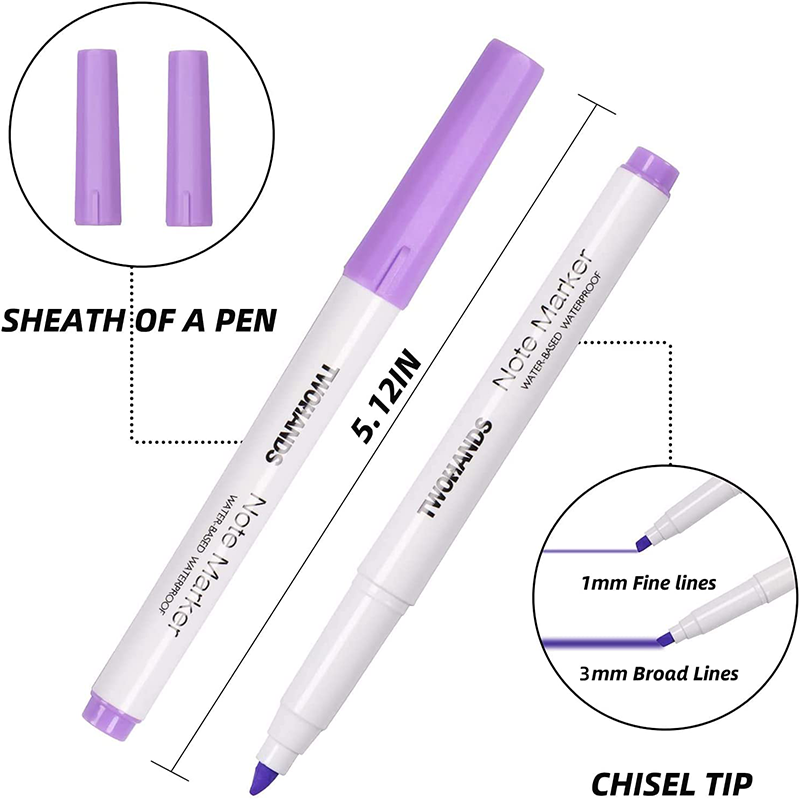
Analyze the business case for sourcing a chisel tip highlighter bulk order. The dual-line width satisfies 90% of standard office and educational requirements. Users can utilize the broad edge for highlighting full sentences. They can switch to the fine point for underlining or writing notes. This versatility eliminates the need to purchase multiple pen styles, streamlining your inventory management.
Tip Material | Durability | Line Precision | Best Application |
|---|---|---|---|
Polyester | High (Resists fraying) | Excellent (Maintains sharp edge) | Heavy daily office and school use |
Felt | Medium (Prone to mushrooming) | Good initially, degrades over time | Short-term promotional items |
Nylon | Very High | Excellent | Premium drafting and architectural work |
The internal delivery system dictates how ink flows from the barrel to the page. You have three primary options to consider when building your specification sheet.
Liquid Ink Tank Systems: These offer consistent, vibrant ink flow. Users can see visible ink levels through a clear barrel. However, they are prone to leakage under atmospheric pressure changes. Do not issue these for frequent air travel or high-altitude field work.
Fiber-Wick (Filter) Systems: This is the standard wholesale configuration. It remains highly stable and cost-effective. The ink sits inside a fibrous core. It can dry out faster if the cap is left off, but it rarely leaks. This is the workhorse of the industry.
Solid Gel & Wax-Based Highlighters: These stick formats do not dry out even when uncapped for days. They never bleed through thin papers. They provide a smooth, dry application. However, they lack the crisp precision of a traditional liquid chisel tip.
Compare standard water-based liquid ink against dry-safe formulas. Water-based options remain highly cost-effective for general use. Dry-safe inks cost slightly more but survive longer on a desk without a cap. If you are supplying a busy office where caps are frequently lost, the dry-safe upgrade pays for itself by reducing replacement rates.
Analyze ink viscosity and absorption rates. The formula must prevent patchiness on porous papers. Skipping or uneven ink deposits frustrate users. The ink must also resist feathering on low-GSM copy papers. Establish technical baselines for UV resistance. The color should not fade significantly over time. Cap-off time is critical. Measure the exact duration the marker can remain uncapped before drying out permanently. We require a minimum of 4 hours cap-off time for standard office deployments.
You must verify the chemical safety of your products. Outline the critical importance of partnering with a verified non-toxic highlighter supplier. Toxic solvents pose severe health risks to end-users. You cannot afford the liability of distributing non-compliant chemicals, especially in educational or healthcare settings.
List required certifications for global distribution. You need REACH compliance for European markets. The US market requires ASTM D-4236 certification. Always request heavy metal testing protocols. Do not accept products without recent, valid laboratory reports. If a factory hesitates to provide these documents, walk away immediately. There are plenty of compliant manufacturers available.
Color choice impacts daily productivity and document management. You must select shades based on functional requirements, not just personal preference. A poorly chosen color can render a document unreadable after scanning.
Evaluate the shift toward pastel shades in modern corporate environments. Colors like mint, lavender, and peach reduce eye strain during prolonged reading. They offer a softer contrast against white paper. Many users prefer pastels for long study sessions or reviewing massive legal briefs. The softer tones do not overwhelm the eye.
Assess the functional necessity of classic high-visibility fluorescent shades. Yellow, pink, orange, and green remain essential for quick data-scanning. These colors grab attention instantly. They work best for urgent memos, inventory tags, and critical data points. When you need someone to look at a specific number immediately, fluorescent yellow is still the undisputed champion.
Identify photocopy-safe colors to prevent document destruction. Fluorescent yellow is universally scannable. It does not obscure text during black-and-white photocopying. The scanner light passes right through the yellow pigment. This ensures the highlighted text remains perfectly legible on the copy.
Warn your team against deep blue, purple, or dark green shades for archival projects. These colors frequently render as dark gray or black when scanned. This blackout risk obliterates the underlying text. Stick to lighter shades for any documents requiring digital archiving. We have seen entire filing systems compromised because a department standardized on dark blue highlighters.
Your branding must survive the lifespan of the pen. Poor printing reflects badly on your organization. If the logo chips off after a week, it signals low quality to your clients.
Evaluate different printing methodologies based on your artwork. Pad printing works best for curved barrels and simple 1-2 color designs. Screen printing accommodates larger wrap-around graphics. UV full-color printing offers high fidelity but comes at a higher cost. You must match the printing method to the complexity of your logo and your budget constraints.
Assess the longevity of the print against friction. Hand sweat and skin oils degrade cheap ink quickly. Ensure the brand logo remains intact throughout the product's lifecycle. Request abrasion test results from your supplier. We routinely perform a simple tape-peel test on pre-production samples to verify ink adhesion. If the logo lifts off with standard office tape, the printing process is flawed.
Analyze barrel materials for durability and ink preservation. Polypropylene (PP) provides excellent vapor barrier properties. It keeps the ink fresh for years. Acrylonitrile Butadiene Styrene (ABS) plastic offers superior impact durability. It withstands drops on hard floors. For liquid ink tanks, PP is almost always required to prevent evaporation.
Evaluate the cap design carefully. You need snap-fit security to prevent accidental opening in bags. Check the pocket clip durability. Inspect the internal sealing gaskets. A tight gasket prevents premature ink evaporation. Listen for a distinct click when capping the pen. That click indicates a positive seal has been formed.
Your supply chain strategy determines your lead times and product uniqueness. Choose the model that fits your operational constraints. Do not force a custom manufacturing run if you need products in two weeks.
Define when to use an OEM highlighter manufacturer. You need an OEM for custom barrel molds or proprietary ink colors. They can build unique multi-tip configurations. They also source eco-friendly recycled materials upon request. If you are launching a retail brand, you must go the OEM route to differentiate your product from generic office supplies.
Discuss the realities of OEM partnerships. You will face higher Minimum Order Quantities (MOQs). Expect longer lead times for tooling and mold creation. You must also enforce strict Intellectual Property (IP) protection to prevent unauthorized reproduction of your designs. Draft clear manufacturing agreements and conduct regular factory audits to ensure compliance with your specifications.
Outline the evaluation criteria for wholesale distributors. When looking for highlighter pen wholesale options, check inventory depth first. Compare domestic versus international shipping times. Review their tiered volume discounts carefully. A good wholesaler acts as a buffer, holding inventory so you do not have to tie up capital in warehouse space.
Identify red flags in wholesale sourcing. Avoid suppliers unwilling to provide recent batch testing reports. Never buy from a distributor who refuses to send physical pre-production samples. You must test the product in your own hands before committing funds. If they claim samples are too difficult to arrange, they are likely brokering low-tier goods they have never physically inspected.
Sourcing Model | Best For | Typical MOQ | Lead Time | Customization Level |
|---|---|---|---|---|
Wholesale Distributor | Standard office supplies, fast deployment | 500 - 1,000 units | 1 - 2 weeks | Surface printing only (Logo) |
OEM Manufacturer | Unique designs, proprietary colors | 10,000+ units | 8 - 12 weeks | Full structural and chemical control |
Procurement is about risk management. The cheapest pen often costs the most in the long run. You must look past the initial unit price and evaluate the failure rate.
Examine the hidden costs of ultra-low-cost imports. You might receive dried-out inventory upon arrival. Inconsistent ink volumes per pen lead to rapid depletion. Users will throw them away after a few days. This creates massive waste and forces you to reorder much sooner than anticipated.
Calculate the return on investment of paying a fractional premium. Guaranteed shelf-life typically runs 18-24 months for quality water-based markers. Paying a few cents more per unit ensures the product actually works when pulled from the supply closet. It also prevents the administrative headache of processing returns for defective batches.
Establish a robust QC protocol immediately. Require pre-shipment inspections using the Acceptable Quality Limit (AQL) standard sampling method. This catches defects before the container ships. You want to find problems on the factory floor, not in your receiving dock.
Mandate physical sample testing for cap seal integrity by leaving pens in a warm room for 48 hours.
Perform drop testing from standard desk height to ensure barrels do not crack.
Verify ink flow consistency by drawing continuous lines to check for skipping.
Conduct a tape-peel test on all printed logos to verify ink adhesion.
Request compliance documentation (ASTM/EN71) from all potential vendors before discussing pricing.
Order a varied sample pack to test ink performance on your specific paper types and substrates.
Audit the supplier's QA processes and mandate AQL pre-shipment inspections for all bulk orders.
Finalize your color palette based on scanning and archival requirements to prevent document blackout.
A: Standard MOQs range from 500 units for domestic blank stock to 10,000+ units for direct-from-factory custom orders. Distributors holding local inventory offer lower minimums, while custom manufacturing requires larger runs to justify setup costs.
A: The chisel tip offers unmatched versatility. It allows users to create broad strokes for highlighting full lines of text and fine lines for underlining. This dual functionality reduces the need to purchase multiple pen types for the office.
A: Request third-party laboratory testing reports directly from the supplier. Verify documents like ASTM D-4236 or REACH compliance certificates. You can contact the testing laboratory listed on the certificate to confirm its authenticity.
A: OEMs build the product from scratch, allowing for complete structural and chemical customization. Distributors sell pre-manufactured, off-the-shelf items and typically only offer surface-level branding like pad printing your logo.
A: UV full-color printing and pad printing are the most durable. UV printing cures the ink instantly, creating a hard, scratch-resistant layer. Pad printing bonds well with plastic barrels, ensuring the logo survives daily friction and hand oils.
A: A quality marker typically lasts 1.5 to 2 years in storage. Shelf life depends heavily on the cap seal quality and the barrel material's vapor barrier properties. Store them horizontally in a temperature-controlled environment to maximize longevity.
A: Fluorescent yellow is the industry standard for scannability. The light from scanners and copiers passes through the yellow pigment without registering it as a dark mark, ensuring the underlying text remains perfectly legible on the copy.