Views: 256 Author: Site Editor Publish Time: 2026-02-16 Origin: Site
Parents and educators often wonder if the tools we use for creativity are secretly harboring risks. When you pop the cap off a standard marker, that sharp, chemical smell is hard to miss. It fills the room quickly. Naturally, this leads to a vital question: Are low odor whiteboard markers safe for kids?
As we shift toward more health-conscious classrooms and playrooms, understanding the chemistry behind these erasable markers is essential. This guide dives deep into safety standards, chemical compositions, and why choosing the right colorful whiteboard markers matters for your child's wellbeing.
The term "low odor" isn't just a marketing gimmick; it represents a fundamental shift in how whiteboard markers are manufactured. Traditional markers often relied on Xylene or Toluene as solvents. These chemicals keep ink liquid but release strong Volatile Organic Compounds (VOCs) into the air.
Most low odor whiteboard markers today use alcohol-based solvents instead. These alcohols evaporate without the pungent, dizzying scent of older formulas. For kids, this is a game-changer. Their respiratory systems are more sensitive than adults. By reducing the chemical "off-gassing," we create a safer environment for focused learning and play.
A strong smell usually indicates a high concentration of solvents. In a small, unventilated bedroom or a crowded classroom, these fumes can cause headaches or nausea. Low odor technology ensures that the office whiteboard markers adapted for home use won't irritate a child's nose or throat during a long drawing session.

When evaluating if whiteboard markers are safe for kids, we must look at the ingredients list. Most reputable brands prioritize non-toxic formulations. The core components usually include:
Pigments: The concentrated color.
Resin: The "glue" that makes the ink stick to the board.
Solvent: The liquid carrier (usually Isopropyl Alcohol or Ethanol in low odor versions).
Release Agent: This allows the ink to be erasable once it dries.
To ensure these colorful markers are truly safe, look for the AP (Approved Product) seal from the ACMI (Art and Creative Materials Institute). This seal confirms the product contains no materials in sufficient quantities to be toxic or injurious to humans, including children.
| Chemical Component | Traditional Markers | Low Odor Markers | Safety Impact |
| Main Solvent | Xylene / Toluene | Alcohol-based | Drastically reduces toxicity |
| VOC Levels | High | Very Low | Better for indoor air quality |
| Allergen Risk | Significant | Minimal | Safer for sensitive kids |
Classrooms are high-traffic areas where dozens of bullet tip whiteboard markers might be in use simultaneously. In such an environment, air quality degrades rapidly. Low odor technology is no longer a luxury; it is a standard for modern education.
Teachers prefer these whiteboard markers because they don't trigger sensory sensitivities in students. Some children are highly reactive to strong smells, which can lead to a lack of focus or even behavioral issues. By using washable whiteboard markers with low scent profiles, schools ensure that the only thing students concentrate on is the lesson at hand.
No Lingering Scents: The room doesn't smell like a chemical factory after a math session.
Reduced Skin Irritation: Kids often get ink on their hands. Alcohol-based erasable markers are generally milder on the skin.
Longevity: Many high-quality dry erase markers now offer long cap-off times without sacrificing their low-scent properties.
The physical design of whiteboard markers also plays a role in safety and ease of use. For younger children, the bullet tip whiteboard marker is often the superior choice.
A bullet tip provides a consistent line width regardless of the angle at which a child holds it. This encourages proper grip development. From a safety perspective, these tips are often sturdier. They don't fray as easily as chisel tips, meaning there are fewer small fiber particles for a child to potentially inhale or pick at.
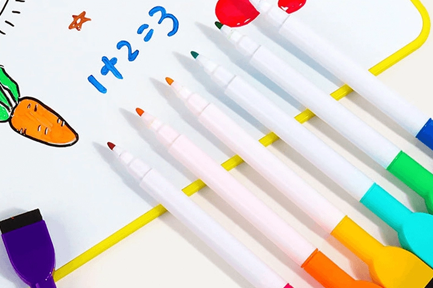
Colorful whiteboard markers with a bullet tip are perfect for:
Letter Tracing: The consistent line helps kids follow shapes.
Detailed Drawing: They allow for more creativity than bulky chisel tips.
Labeling: Great for office or home organization tasks where kids help out.

Is a marker truly "kid-safe" if it stains their skin and clothes forever? Probably not. Washable whiteboard markers add an extra layer of parental peace of mind. While most dry erase markers are designed to be wiped off non-porous surfaces, washable versions are formulated to come out of fabrics and off skin with just soap and water.
Often, washable formulas use even milder surfactants and pigments. This reduces the need for harsh scrubbing or the use of rubbing alcohol to clean a child's hands. When you choose washable, colorful markers, you are choosing a product designed specifically for the chaotic reality of childhood.
Note: Always check the label. Not all low odor whiteboard markers are strictly "washable" from clothes. If your child is prone to "wearing" their art, look for the specific washable designation.
When sourcing whiteboard markers for large-scale distribution or educational supply, the "behind-the-scenes" of the factory matters immensely. At Cicor, we understand that B2B partners require more than just a pretty product; they need reliability, volume, and uncompromising safety standards.
As a leading manufacturer in the writing instrument industry, Cicor operates a state-of-the-art factory dedicated to precision and safety. We don't just assemble products; we engineer them. Our facility utilizes advanced automated production lines that ensure every bullet tip and ink reservoir meets strict global standards.
B2B Capacity: We provide high-volume OEM and ODM services, tailoring whiteboard markers to your brand's specific safety and aesthetic needs.
Technical Mastery: Our R&D team focuses on perfecting low odor formulas that maintain vibrant color without the use of harmful solvents.
Global Compliance: We hold various international certifications, ensuring our office and school supplies are fit for global markets, prioritizing non-toxic materials for end-users.
By partnering with a professional factory like ours, businesses can confidently provide colorful whiteboard markers that parents trust and kids love.
Even the safest non-toxic whiteboard markers require supervision. The primary safety concern shifts from "fumes" to "physical misuse" as kids get younger.
The caps of whiteboard markers are small. Most modern designs include "ventilated caps" which allow air to pass through if swallowed, but they still pose a significant choking risk for toddlers. Always store your office whiteboard markers out of reach of children under three years old.
While the ink in an AP-certified marker is non-toxic, it is not food. If a child sucks on the bullet tip, they might experience a stained tongue and a mild stomach upset.
What to do: Have the child rinse their mouth with water.
Prevention: Use washable markers under adult supervision to ensure they stay on the board and out of mouths.
How you store your whiteboard markers affects their safety and performance. If a marker leaks because it was stored improperly, the concentrated ink is more likely to cause a mess or skin irritation.
Horizontal is Best: Store colorful markers horizontally. This prevents the tip from drying out or becoming over-saturated with ink.
Cap it Tight: Ensure the cap "clicks." This prevents the low odor solvents from evaporating, which can lead to a crusty, unusable bullet tip.
Cool, Dry Place: Heat can cause the pressure inside the marker to change, leading to leaks. Keep your office supplies away from direct sunlight.
If a marker starts to smell "off" or develops a strange crust, it’s time to replace it. Old whiteboard markers can sometimes harbor bacteria if used on dirty surfaces repeatedly, or the chemical balance may shift as the solvent evaporates.
So, are low odor whiteboard markers safe for kids? The answer is a resounding yes, provided you choose high-quality, non-toxic products. By moving away from harsh solvents like Xylene and toward alcohol-based, low odor formulas, manufacturers have made it possible for kids to explore their creativity without the headache-inducing fumes of the past.
When shopping, prioritize AP-certified, washable, and bullet tip options. These features combine to create a tool that is physically easy for kids to use and chemically safe for their developing bodies. Whether for a home art station or a busy classroom, the right whiteboard markers make all the difference in fostering a healthy, imaginative environment.
1. What happens if my child draws on their skin with a whiteboard marker?
Most low odor whiteboard markers are non-toxic. If the ink gets on the skin, simply wash it with warm soap and water. If it's a washable version, it should come off easily. Avoid using harsh chemicals like nail polish remover on a child's skin.
2. Can the smell of these markers trigger asthma?
While low odor versions are much safer, any scent can be a trigger for extremely sensitive individuals. However, for the vast majority of children with asthma, low odor markers do not pose a respiratory risk in well-ventilated rooms.
3. Are "Dry Erase" and "Whiteboard" markers the same thing?
Yes, the terms are used interchangeably. Both refer to erasable markers designed for non-porous surfaces. Both come in colorful varieties and both offer low odor versions.
4. How can I tell if a marker is truly non-toxic?
Look for the AP seal or a statement saying "Conforms to ASTM D-4236." This is the gold standard for art supply safety in the US and many international markets.