Views: 198 Author: Site Editor Publish Time: 2025-12-23 Origin: Site
For global importers, sourcing markers is no longer just about vibrant colors or ergonomic barrel designs; it is a high-stakes game of regulatory adherence. Compliance is not merely a safety precaution—it is your primary license to access the market. Failure to produce valid test reports can lead to immediate Amazon listing suppression, costly seizures by U.S. Customs and Border Protection (CBP), or public brand damage through EU RAPEX recalls. Whether you are importing professional Art Markers, office-grade stationery, or specialty items like a Glitter Marker set, the regulatory landscape is unforgiving.
The challenge lies in the nature of the product. While you can visibly inspect the plastic molding or test the ink flow, chemical compliance is an "invisible" quality that carries the highest liability. A visually perfect product can still contain prohibited heavy metals or restricted solvents. This guide serves as a comprehensive roadmap for validating supplier claims regarding EN71, ASTM, and REACH standards. We will help you navigate the complex paperwork required before you ever issue a Purchase Order, ensuring your goods move smoothly from the factory floor to the customer’s hand.
Geography Matters: The U.S. (ASTM/CPSIA) and EU (EN71/REACH) have distinct testing protocols; a "universal" report rarely exists.
The "Part 3" Trap: Many suppliers provide EN71 Part 1 & 2 (physical/flammability) reports but skip Part 3 (chemical migration), which is the most expensive and critical test for ink.
Labeling vs. Safety: ASTM D-4236 is a labeling standard for chronic hazards, while ASTM F963 is a safety standard for children’s products—buyers often confuse the two.
Cost Reality: Expect a 5–15% unit cost premium for fully compliant markers due to higher quality pigments and testing fees.
When sourcing stationery, you must determine which paperwork is mandatory based on two critical factors: where you sell and who holds the pen. A report that satisfies U.S. authorities often holds no weight in the European Union, and vice versa. Understanding these distinctions prevents the costly mistake of paying for the wrong tests.
In the United States, regulations distinguish clearly between general art materials and products intended specifically for children. This distinction often confuses new buyers.
ASTM D-4236 (LHAMA): This is mandatory for all art materials, regardless of whether they are for adults or children. It requires a toxicological risk assessment to identify chronic hazards. The key deliverable here is the "Conforms to ASTM D-4236" statement printed on the barrel. It confirms a toxicologist has reviewed the formula, even if the product is non-toxic.
ASTM F963 & CPSIA: These are safety standards mandatory specifically for markers marketed to children (generally under 12 years old). This requires third-party lab testing for total lead content and phthalates in the plastic components.
CPC (Children’s Product Certificate): This is not a lab report but a self-issued document by the importer. However, you cannot issue it without underlying passing test results from a CPSC-accepted laboratory.
The EU approach is generally more rigorous regarding chemical composition, focusing heavily on what migrates from the product into the human body.
EN71 Standards: Often called the "Gold Standard" for toy safety, this series of tests is non-negotiable for products appealing to children.
REACH (SVHC): This regulation checks for Substances of Very High Concern in both the plastic barrel and the ink chemistry. It ensures the product does not contain restricted carcinogens or reproductive toxins.
CE Marking: This mark is a self-declaration of conformity. You cannot simply print a CE logo on your packaging; it must be backed by a comprehensive Technical File containing all valid test reports mentioned above.
Different types of writing instruments carry different chemical risks. Knowing these risks helps you scrutinize the right parts of a test report.
| Product Type | Primary Chemical Risk | Key Test Focus |
|---|---|---|
| Art Markers & Glitter Markers | Heavy Metals (Lead, Cadmium, Arsenic) | High scrutiny on metallic inks and bright yellow/orange pigments. |
| Dry Erase Marker & Wet Erase Marker | Volatile Organic Compounds (VOCs), Solvents | Toxicological Risk Assessment for Xylene, Toluene, and Benzene. |
For a Glitter Marker, the metallic flakes and bright pigments often rely on heavy metals to achieve their luster. This makes them frequent candidates for EN71-3 failures. Conversely, a Dry Erase Marker is scrutinized for its solvent base; strong odors often indicate toxic solvents that may fail US toxicity reviews.
Smart buyers move beyond reading the PDF certificate title. You must understand the specific chemical limits your product must pass to ensure safety and compliance.
EN71-3 is the most critical and expensive test for ink-based products. It tests for the migration of 19 heavy metals—including Arsenic, Barium, Lead, and Mercury—from the ink and nib if a child were to suck or chew on them.
This is where many "cheap" quotes fail. Cheaper pigments used in budget Art Markers often exceed these limits to cut costs. If a supplier offers a price significantly lower than the market average, they may be using non-compliant ink formulations that will fail this specific migration test.
The TRA is an evaluation of acute and chronic toxicity. Unlike a simple "pass/fail" based on a number, this involves a toxicologist reviewing the complete formulation.
Sensory Checks: You can often perform a preliminary check yourself. A strong, pungent chemical odor in a Wet Erase Marker or whiteboard marker often indicates the presence of restricted ketones or aromatic hydrocarbons like Toluene. If the sample smells like industrial paint thinner, it signals a likely TRA failure and potential consumer complaints about headaches or dizziness.
Safety is not just chemical; it is also physical. These standards test the mechanical integrity of the product.
Small Parts Cylinder: Labs use a specialized cylinder to see if detached parts fit inside. Caps on markers must be ventilated (to allow airflow if swallowed) or be too large to present a choking hazard.
Sharp Edges: The plastic molding of the barrel is checked for burrs or sharp seams that could cut a user.
This testing focuses on the plastic barrel (usually PP or ABS) and any external coatings. Regulations restrict phthalates—often used to soften plastics—because they are endocrine disruptors.
Pro Tip: Virgin Polypropylene (PP) barrels generally have much better compliance pass rates than recycled plastics of unknown origin. Recycled plastics (PCR) can sometimes carry legacy contaminants that trigger failures in lead or phthalate testing.
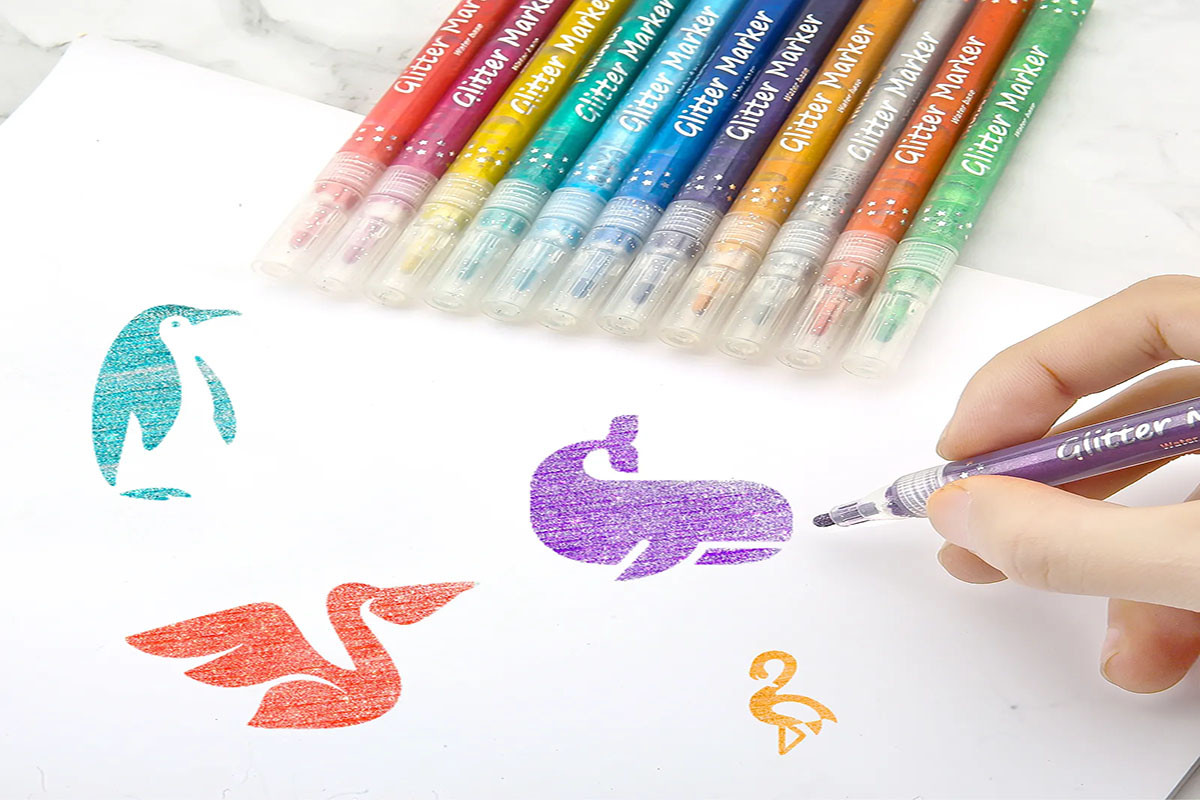
In the B2B marketplace, receiving a PDF file named "Certificate" is not proof of compliance. You must distinguish between a valid certificate, a Photoshop job, or an irrelevant report that doesn't cover your specific goods.
First, establish a visual link between the paperwork and the product. Scroll to the appendix of the report where the lab attaches photos of the samples they tested.
Does the photo match the exact marker design, color, and nib type you are buying? A common red flag is receiving a report for a "Black Dry Erase Marker" when you are importing a "Neon Glitter Marker" set. The chemical composition of black ink is vastly different from neon or metallic ink; one report cannot cover the other.
Dive into the test results table. You are looking for specific numerical data regarding element migration (e.g., Lead < 10 mg/kg).
Red Flag: Many suppliers will provide a report that says "Pass" for EN71-1 (Mechanical) and EN71-2 (Flammability) but shows "N.R." (Not Requested) for EN71-3. Or, they might omit the Part 3 section entirely. Since Part 3 is the most expensive test, suppliers often skip it. If the ink chemistry is unverified, the product is essentially non-compliant for the EU market.
Ensure the testing laboratory is accredited by ISO/IEC 17025. Major names like SGS, Intertek, TÜV, and BV are standard, but smaller labs can be valid if accredited.
Check the dates carefully. Safety standards update regularly (e.g., moving from F963-17 to F963-23). Reports that are older than 1–2 years may reference obsolete legal limits, rendering them useless for current imports.
A "Golden Sample" might have passed the test, but will the mass production match? Manufacturers may use high-quality ink for the sample sent to the lab and switch to cheaper ink for your order. Demand that the certificate ID or batch number be printed on the inner packaging. This creates a traceability link between your specific production run and the safety dossier.
Understanding how safety certifications impact your bottom line is crucial for accurate pricing strategies. Compliance is an investment, not just a hurdle.
You should expect a **5–15% unit cost increase** for certified non-toxic inks and virgin plastics compared to generic bulk sourcing. This premium covers the higher cost of safe raw materials and the amortization of testing fees.
Lab fees are significant. A full EN71-3 test can cost hundreds of dollars per color. If you have a 12-color set, the testing cost allows no room for "cheap" pricing strategies.
Suppliers generally require higher Minimum Order Quantities (MOQs)—typically 1,000 to 3,000 sets—for certified custom orders. This volume is necessary to amortize the fixed costs of testing across enough units.
Low MOQ Risk: Be wary of buying 50 units of "unbranded" markers from a spot market. These small lots usually force you to accept products without specific tracking labels or dedicated test reports, exposing you to high liability.
Yiwu Market: While excellent for low-cost domestic items, Yiwu presents a higher risk of non-compliance for Western imports. Reports here are often missing, expired, or forged.
Export-Focused OEM (e.g., Ningbo/Shantou): Manufacturers in these hubs are more likely to have existing, valid reports (ASTM/EN71) and established chemical supply chains that ensure consistent safety.
Before your goods leave the factory, you must perform a final checklist to ensure all compliance efforts are visible and verifiable.
Your product must speak for itself. Ensure the text "Conforms to ASTM D-4236" is legible on the barrel or the immediate box. For markers intended for children, you must also ensure proper age grading (e.g., "3+") and include any necessary choking hazard warnings if small parts are present.
Under US law (CPSIA), children's products must carry a permanent tracking label. This mark must verify the manufacturer, the location of production, and the date of production. Adhesive stickers are often deemed insufficient; printing this information directly on the barrel or the permanent packaging is preferred to ensure traceability throughout the product's life.
Implement a two-stage verification process to manage risk and budget:
Pre-Production: Verify that the raw materials (ink and plastic pellets) pass standards before mass production begins.
Pre-Shipment: Conduct random sampling of the finished goods. This ensures the factory did not swap expensive safe ink for cheaper toxic ink during the mass production run.
Sourcing art markers is a dual discipline that combines aesthetic performance with strict chemical management. It is not enough for a marker to write smoothly; it must also be chemically inert and legally documented. Compliance is the invisible feature that protects your business from catastrophic legal and financial risks.
Never treat certifications as a "nice to have" addition. For the US and EU markets, they are the license to trade. If a shipment is flagged, no amount of product quality will save it from destruction if the paperwork is flawed. Prioritize suppliers who offer complete transparency—providing full PDF reports rather than blurry screenshots—and who willingly accept third-party inspection to verify those claims.
A: ASTM D-4236 is a labeling standard required for all art materials (adult and child) to warn of chronic health hazards. It requires a toxicologist's review. ASTM F963 is a safety standard specifically for children’s products (under 12), requiring physical tests and limits on heavy metals like lead. Children's markers usually need both.
A: Yes. Alcohol-based markers often contain solvents that require a more rigorous Toxicological Risk Assessment (TRA) to ensure they don't emit harmful VOCs or cause acute toxicity. Water-based markers generally have fewer solvent risks but still require full heavy metal migration testing (EN71-3).
A: Generally, yes, provided the report exactly matches the product you are selling (same factory, same ink, same materials). However, Amazon may require a "Letter of Authorization" from the supplier linking their test report to your specific brand name or ASIN to prove the document applies to your goods.
A: Certifications should be renewed whenever safety standards change (e.g., a new version of ASTM F963 is released) or if the factory changes their material formulation. Best practice is to request updated testing every 12 to 24 months to ensure ongoing compliance with the latest chemical limits.
A: No. "Non-toxic" means the product passes standards like ASTM D-4236 and won't cause immediate harm if used as intended or accidentally ingested in small amounts. "Food grade" implies the material is safe for direct food contact (like edible ink), which is a much higher and different standard. Most markers are non-toxic but not food grade.