Views: 0 Author: Site Editor Publish Time: 2025-08-20 Origin: Site
In the realm of markers, two prominent types often come into discussion: washable markers and whiteboard markers. Both have their unique applications and characteristics, yet they serve different purposes and audiences. Understanding the difference between these two can significantly impact your choice depending on your needs. For those interested in more details about washable markers, you can explore our comprehensive guide on Washable Marker.
Washable markers are specifically designed to be easily removable from skin, clothing, and other surfaces. This feature makes them particularly popular among parents and educators. The ink in these markers is typically water-based, allowing it to be washed out with soap and water. They are often used in environments where messes are likely, such as in classrooms or at home with young children.
The composition of washable markers includes non-toxic dyes and pigments, making them safe for use by children. Their ease of removal from surfaces is attributed to the water-soluble nature of the ink. This characteristic, however, can also mean that the colors might not be as vibrant or long-lasting as those of permanent markers.
One of the primary advantages of washable markers is their safety and ease of use. They are ideal for young children who are prone to accidental marks on skin and clothing. Additionally, the ability to easily clean surfaces after use makes them a convenient option for parents and teachers.
Moreover, washable markers offer a range of colors, encouraging creativity without the worry of permanent stains. This makes them a preferred choice for art projects and educational activities where children can freely express themselves.
Despite their benefits, washable markers do have limitations. The water-based ink can be less vibrant and may fade over time. This can be a drawback for projects that require long-lasting and vivid colors. Additionally, the ink's solubility in water means that exposure to moisture can cause the colors to run or smear.
Another limitation is their unsuitability for use on non-porous surfaces. The ink does not adhere well to surfaces like glass or plastic, limiting their application in certain scenarios.
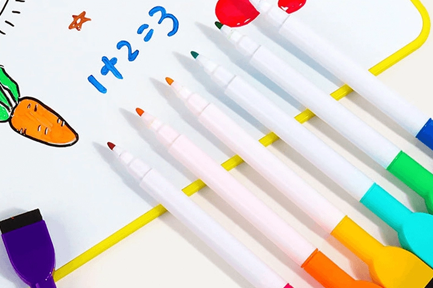
Whiteboard markers, on the other hand, are designed for use on non-porous surfaces such as whiteboards and glass. They contain an ink that is formulated to be easily erasable, making them ideal for temporary writing and drawing.
The ink in whiteboard markers is typically alcohol-based, which allows it to dry quickly and be wiped off easily with a dry cloth or eraser. This quick-drying feature is essential in environments where information needs to be frequently updated, such as in classrooms and offices.
Whiteboard markers offer several advantages, particularly in professional and educational settings. Their quick-drying and erasable nature allows for dynamic presentations and brainstorming sessions. They are available in a variety of colors, enabling users to highlight different points or ideas effectively.
Furthermore, the ink's ability to adhere to non-porous surfaces without smudging makes them ideal for use on whiteboards and glass. This feature is crucial in maintaining clarity and readability during presentations.
While whiteboard markers are excellent for temporary writing, they are not suitable for permanent applications. The ink can be easily erased, which means it is not ideal for projects that require long-term visibility.
Additionally, the alcohol-based ink can emit fumes that may be irritating to some users, especially in poorly ventilated areas. This can be a consideration for those with sensitivities to chemical odors.
When comparing washable markers and whiteboard markers, it is essential to consider the intended use and environment. Washable markers are best suited for environments where ease of cleaning and safety are priorities, such as with young children or in creative settings. Their water-based ink is non-toxic and easily removable, making them a practical choice for parents and educators.
In contrast, whiteboard markers are ideal for professional and educational settings where information needs to be frequently updated and erased. Their alcohol-based ink provides quick-drying and erasable features, making them suitable for dynamic presentations and brainstorming sessions.
In conclusion, the choice between washable markers and whiteboard markers depends largely on the specific needs and environment of the user. Washable markers offer safety and ease of cleaning, making them ideal for children and creative projects. Whiteboard markers, with their quick-drying and erasable features, are better suited for professional and educational settings where temporary writing is required. Understanding these differences can help users make informed decisions about which type of marker to use for their specific applications.
For a deeper understanding of washable markers, including their various applications and benefits, you can visit our detailed page on Washable Marker.
1. Are washable markers safe for children?
Yes, washable markers are designed to be non-toxic and safe for children, making them ideal for use in schools and at home.
2. Can whiteboard markers be used on paper?
While they can be used on paper, whiteboard markers are not ideal for this purpose as the ink may bleed through and is not permanent.
3. How do you remove washable marker stains?
Washable marker stains can typically be removed with soap and water, making them easy to clean from most surfaces.
4. Do whiteboard markers have a strong odor?
Whiteboard markers may emit a mild odor due to the alcohol-based ink, which can be noticeable in enclosed spaces.
5. What surfaces are suitable for whiteboard markers?
Whiteboard markers are best used on non-porous surfaces such as whiteboards, glass, and laminated surfaces.
6. Are there eco-friendly options for markers?
Yes, there are eco-friendly markers available that use sustainable materials and non-toxic inks.
7. Can washable markers be used on whiteboards?
While they can be used, washable markers are not designed for whiteboards and may not erase as easily as whiteboard markers.