


Introduction
Choosing the right marking tool can make the difference between a clean handmade garment and one with uneven seams, misplaced darts, or visible residue. An erasable sewing pen gives DIY makers a practical way to draw temporary guidelines directly on fabric without the roughness of chalk or the permanence of ordinary ink. This article explains why it fits home sewing projects, especially when accuracy, fabric safety, and easy removal matter. You’ll learn how its water-based or heat-sensitive formulas support cutting, stitching, alterations, and detailed pattern work, while helping reduce mistakes during construction. From delicate textiles to everyday cotton, the erasable sewing pen offers a controlled, beginner-friendly approach to fabric marking.
Why Use an Erasable Sewing Pen
In garment construction and DIY clothing projects, accurate fabric marking dictates the success of cutting, darting, and seaming operations. Historically, tracing wheels and chalk dominated the industry, but modern textiles often require non-abrasive, temporary marking solutions. The erasable sewing pen has emerged as a standard tool for both commercial apparel processing and independent designers, bridging the gap between high-visibility drafting and residue-free finishing. By utilizing advanced liquid formulations, these tools eliminate the physical strain and material distortion associated with dragging solid chalk across a cutting table.
What Defines an Erasable Sewing Pen
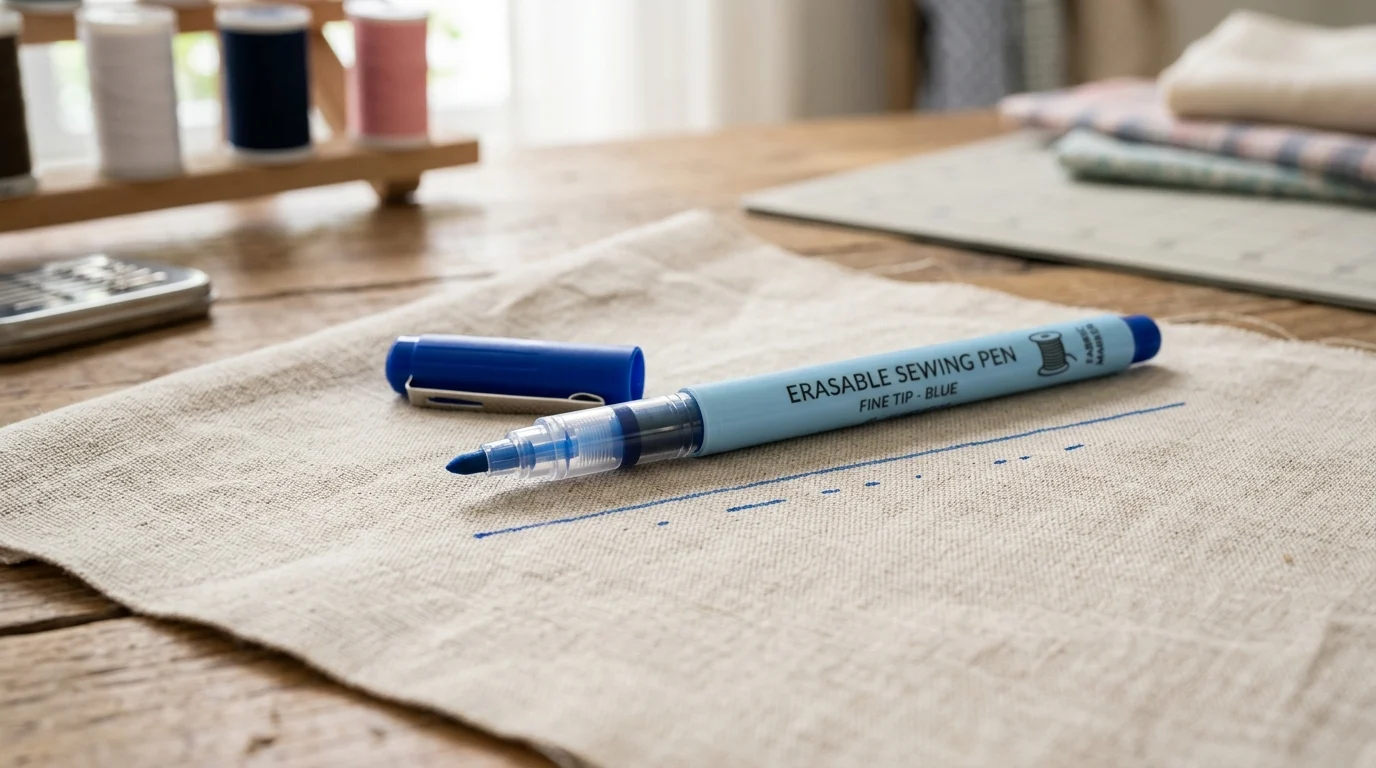
An erasable sewing pen is a specialized marking instrument designed to leave temporary guidelines on textile surfaces. Unlike standard stationery, these tools utilize specialized nibs, typically crafted from durable acrylic, to prevent snagging delicate weaves. Industrial and DIY applications frequently rely on precise specifications, such as a 1.0mm standard tip for general drafting or a 0.5mm Extra Fine Tip Water Erasable Fabric Marker for intricate embroidery and exact seam allowances. This strict dimensional tolerance ensures that pattern lines remain sharp without bleeding into adjacent fibers. A standard industrial pen cartridge typically holds enough ink to yield approximately 400 to 500 meters of continuous linear marking, making it highly efficient for batch processing.
How Water-Based Ink Supports Fabric Marking
The core technology of a water-disappearing pen lies in its specialized water-based ink formulation. When applied to cotton, linen, or synthetic blends, the pigment rests on the fiber surface rather than permanently dyeing the core. Upon contact with water—whether through a damp cloth, a targeted spray bottle, or a final garment wash—the chemical bonds of the ink break down, causing the color to vanish entirely. Depending on the ambient humidity and fabric absorbency, marks can be eradicated in under 5 to 10 seconds of moisture exposure, streamlining the transition from assembly to final pressing without leaving chemical residues.
Erasable Sewing Pen vs Tailor’s Chalk
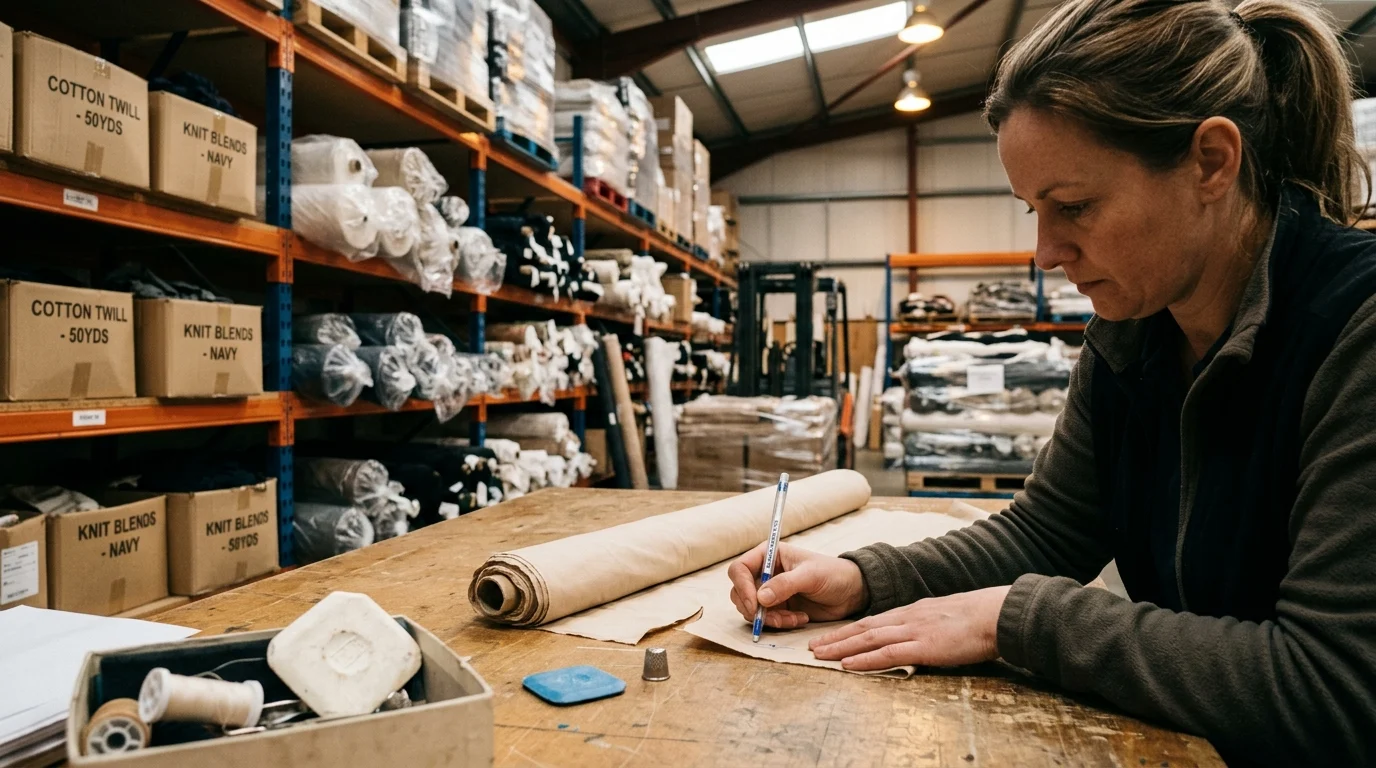
The choice between an erasable sewing pen and traditional tailor’s chalk significantly impacts production efficiency and garment quality. While chalk remains a staple for heavy wools and rough tweeds, it presents distinct limitations when drafting on smooth, fine, or highly textured modern fabrics. Evaluating the mechanical properties of both tools reveals why liquid-based markers are increasingly preferred for precision garment manufacturing and detailed DIY tailoring projects.
Line Precision, Removal, and Fabric Safety
Tailor's chalk typically produces a line width varying from 1.5mm to 3.0mm, which degrades rapidly as the edge wears down during use. This dimensional instability can lead to compounding measurement errors across a large pattern. Conversely, an erasable pen maintains a strict 0.5mm to 1.0mm line width from the first stroke to the exhaustion of the ink cartridge. Furthermore, chalk relies on mechanical friction to leave a deposit, requiring up to 300 grams of downward pressure, which can stretch delicate knits. In contrast, an acrylic-nib pen requires less than 50 grams of pressure to dispense ink smoothly.
| Specification | Erasable Sewing Pen | Tailor's Chalk |
|---|---|---|
| Line Width | 0.5mm - 1.0mm (Consistent) | 1.5mm - 3.0mm (Variable) |
| Marking Mechanism | Water-based liquid ink | Compressed clay/wax friction |
| Application Pressure | < 50 grams | 200 - 300 grams |
| Removal Method | Water application (instant) | Brushing or ironing |
| Residue Risk | Low (if washed properly) | High (dust embedding) |
| Best For | Cottons, linens, silks, synthetics | Heavy wools, denim, canvas |
When to Choose a Water-Disappearing Pen
A water-disappearing pen is the optimal selection when structural accuracy is paramount, such as when plotting buttonholes, darts, or complex embroidery motifs. DIY clothes makers and commercial seamstresses should deploy these pens on washable textiles where water application will not cause water spots or shrinkage. Because the ink requires moisture to dissolve, it remains stable during dry handling, ensuring that critical alignment marks do not rub off prematurely during complex assembly processes that may take upwards of 12 to 24 hours of handling and machine stitching.
How to Select and Use an Erasable Sewing Pen
Integrating liquid fabric markers into a sewing workflow requires a systematic approach to ensure both precision and fabric integrity. While the underlying chemistry is designed for temporary adhesion, variations in textile manufacturing—such as residual sizing, finishing chemicals, or synthetic fiber blends—can alter how the ink behaves. Proper selection, rigorous preliminary testing, and correct storage protocols mitigate the risk of ruined garments and wasted materials.
Test Fabric Before Marking
Before executing marks on the final garment panels, professionals must conduct a preliminary swatch test. Apply the pen to a 5cm by 5cm scrap of the project fabric, mirroring the exact pressure and line density intended for the final piece. Allow the ink to set for a minimum of 30 minutes, then apply water to activate the erasing mechanism. Crucially, operators should wait a full 24 hours after the test area has dried to ensure no residual ghosting, yellowing, or chemical bleaching occurs. This standard operating procedure guarantees that the water-based ink is fully compatible with the specific dye and sizing profile of the textile.
Choose by Fabric Type and Project Needs
Selecting the appropriate marker depends heavily on the fabric's physical characteristics and the project's timeline. For tightly woven cottons or smooth synthetics, a fine tip prevents ink from wicking outward along the warp and weft yarns. Additionally, operators must consider color contrast; blue or pink inks provide high visibility on light textiles, whereas specialized white water-erasable ink is engineered for dark fabrics, though it often requires 10 to 15 seconds to fully develop opacity after application. Finally, proper storage is critical; pens should be stored horizontally at temperatures between 10°C and 25°C to maintain uniform ink distribution. Verify the manufacturing date, as water-based fabric markers typically possess a shelf life of 12 to 18 months before the internal solvent begins to evaporate.
Key Takeaways
- The most important conclusions and rationale for Erasable Sewing Pen
- Specs, compliance, and risk checks worth validating before you commit
- Practical next steps and caveats readers can apply immediately
Frequently Asked Questions
Why is an erasable sewing pen useful for DIY clothes?
It creates clear, temporary lines for cutting, darts, seams, buttonholes, and embroidery without dragging or stretching fabric like chalk can.
How do erasable sewing pen marks disappear?
Most use water-based ink that vanishes when touched with a damp cloth, spray of water, or during the final garment wash.
Which fabrics work best with a water erasable sewing pen?
They work well on washable cotton, linen, silk, and many synthetics. Always test first, especially on delicate or water-sensitive fabrics.
Is an erasable sewing pen better than tailor’s chalk?
For precision work, yes. It gives thinner, more consistent lines and needs less pressure, making it better for delicate DIY clothing projects.
What tip size should I choose for sewing marks?
Use a 1.0mm tip for general garment marking and a 0.5mm extra-fine tip for embroidery, seam allowances, and detailed pattern work.
